

Molas are one of Panama’s most widely recognized cultural symbols and an artistic expression deeply connected to the identity of the Guna people. For international students at Spanish Panama Language School, learning Spanish in Panama also means exploring its history, its Indigenous peoples, and its living traditions. For this reason, the study of the mola and its meaning has become an excellent cultural immersion activity within the Friday experiences offered by the school in Panama City.
What Does a Mola Mean? Interpretation of Traditional Design
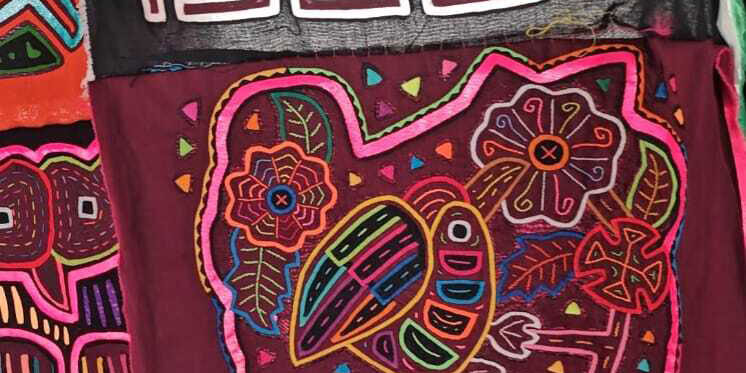
A mola is a textile artwork created by Guna women using the reverse appliqué technique, in which several layers of colored fabric are cut and hand-sewn to form detailed, symbolic designs.
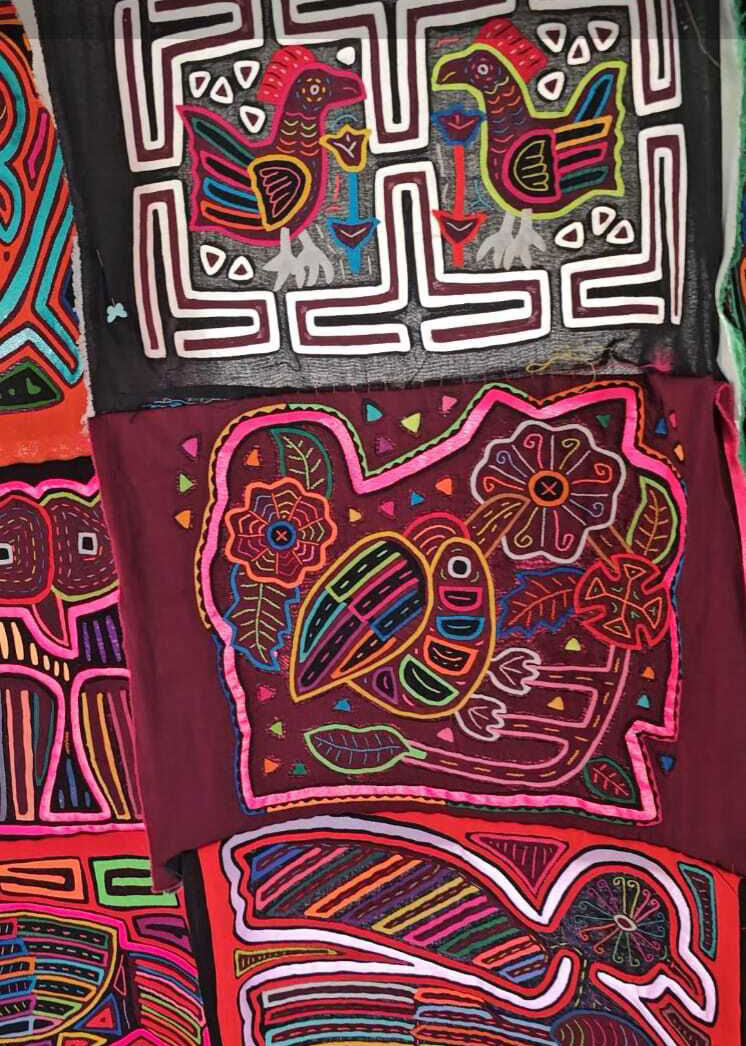
The reference mola contains three fundamental elements commonly found in traditional pieces:
1. Stylized birds
Birds represent:
-
Freedom and movement
-
A connection between the natural and spiritual worlds
-
The importance of the jungle environment in the Guna worldview
They are among the most frequent motifs because they express harmony, clarity, and the constant presence of nature.
2. Geometric borders
Labyrinth-like patterns symbolize:
-
Ancestral paths
-
Spiritual protection
-
The complexity of life
These designs are an essential part of the Guna aesthetic style and frame the main figure of the mola.
3. Floral and plant elements
Flowers and leaves represent:
-
Fertility
-
Renewal
-
The feminine connection with the earth
The combination of birds, flowers, and geometric shapes conveys a message of balance and respect for nature.
History of the Mola in Panama
The origin of the mola dates back to times before the arrival of Europeans. Guna women originally decorated their bodies with painted designs; when new fabrics appeared in the 19th century, these traditional motifs were transformed into sewn textiles.
The result was a unique art form that today is an essential part of the traditional dress of Guna women, especially in the Guna Yala region (San Blas).
Although the fabrics themselves come from external influences, the artistic language, symbolism, and visual interpretation are entirely Indigenous. Each mola is an expression of identity, knowledge, and cultural memory.
Do the Emberá or Wounaan also make molas?
No.
Molas are exclusive to Guna culture.
The Emberá and Wounaan are known for:
-
Woven baskets
-
Cocobolo wood carvings
-
Geometric body designs
But the mola is strictly part of the Guna cultural heritage.
Where to Buy the Best Molas in Panama
Students and visitors can find authentic molas in several locations around the city:
1. Casco Viejo – Plaza Francia and Las Bóvedas
Excellent quality; many Guna artisans sell their work directly.
2. Avenida Central (Santa Ana)
Good prices and the possibility of finding older molas.
3. Amador Causeway
Guna artisans offer both traditional and modern pieces.
4. Guna Yala (San Blas)
The most authentic location, ideal for museum-quality pieces.
How to Identify a Good Mola
-
Small, hand-sewn stitches
-
Multiple layers of overlapping fabric
-
Clean, symmetrical edges
-
Balanced and detailed design
An authentic mola can take weeks or even months of artisanal work.
A Recommended Activity of past Spanish Panama Language School students
This was one of our Friday cultural activities as requested by a Spanish student group at our school.
These experiences combine language + culture + history, which defines the immersion-based approach of Spanish Panama Language School in El Cangrejo.